Search here
 Log In
Federal Minister For Planning, Development And Reform
CV:
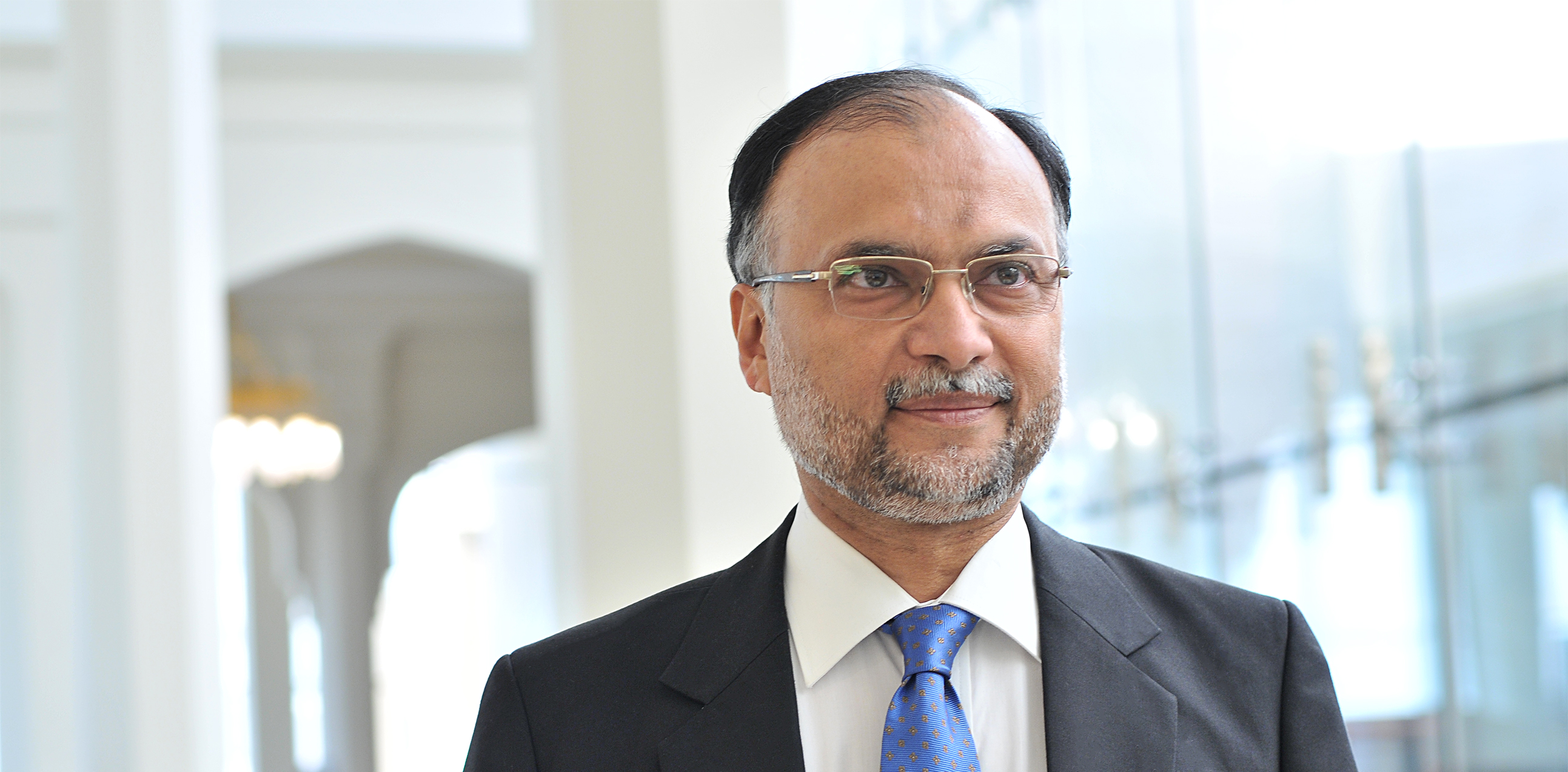
Born in 1958, Ahsan Iqbal is a Pakistan Muslim League - Nawaz (PML-N) stalwart. He has been elected as an MNA four times – in 1993, 1997, 2008 and 2013. Iqbal has been associated with prestigious educational institutions such as Government College Lahore, University of Engineering and Technology (Lahore), University of Pennsylvania, Georgetown University and Harvard University. He hails from a family with a political background. His mother, Apa Nisar Fatima was a parliamentarian and his maternal grandfather, Chaudhry Abdul Rehman Khan, was a lawmaker in India before independence.
Blurb:
The best way to predict the future is to create it and better future can only be created through vision.
Evolve: As an engineer and business graduate by education and a politician by profession, how do you rationalize this transformation?
Ahsan Iqbal: I personally believe that evolutionary transition is the only pliable option to ensure transformation of the lives of people for betterment. The process of change has become an inevitable force in the era of information and technology which needs to be institutionalized through democratic conventions and people-centric development initiatives.
Evolve: In your view what is the relation between economic growth and political stability especially with reference to Pakistan that is 7th most populous country of the world?
Ahsan Iqbal: Political stability and economic growth are intrinsically linked with each other. China, having been the most populous country of the world, has emerged as world’s second largest economy by embracing the principles of political stability and social solidarity. Unfortunately, Political stability in Pakistan has remained elusive since independence. The schismatic relationship between civil and military administration, confusion over the role of religion in country, martial laws, adverse relations with neighboring countries etc were the reasons for lurking political instability and increasing reliance on the policy of adhocism in Pakistan. The spirit of CPEC is to complement Pakistan's geographic richness and demographic dividend to each other to make Pakistan one of the top 25 economies of the world by 2025.
Evolve: Please throw some light on “Vision 2025”
Ahsan Iqbal: The best way to predict the future is to create it and better future can only be created through vision. Growth and development oriented vision is no longer an abstract process; it has rather turned out to be a science having prescribed rules and proven methods. There is a Japanese Proverb which says “Vision without action is a daydream; Action without vision is a nightmare”. The Vision 2025 exercise was started under the guidance of the Prime Minister to restore the tradition of Future planning in Pakistan. It was drawn up after consultation with a wide range of stakeholders including parliamentarians, representatives of political parties, federal ministries, provincial governments, business leaders, universities, NGOs etc. Vision 2025 divides its challenges and goals into a set of seven pillars identified as the key drivers of growth which will transform Pakistan into a vibrant and prosperous nation by 2025. In addition to seven pillars, Vision 2025 identifies five key enablers which are critical to entire scheme of growth and development.
Evolve:How will the government tackle the issue of security to attract foreign investment in current scenario where Karachi operation and biggest of all Operations Zarb-e-Azb are in full swing?
Ahsan Iqbal: The future wars will not be fought on the basis of how many nukes and armaments are possessed by the nation, though military superiority is still one of the elements of national power. It is the strong economy and technology which are the yardsticks of national development in a highly competitive global world. Investment, either domestic or foreign, knows neither religion nor culture in the globalized world; what it knows is only the peace and security for good return. Vision 2025 has attributed peace and security as the motivational factor to attract foreign investment in the country. The government has launched a decisive military operation against the extremists, who are confined only to some remote areas. The security situation of Karachi and Quetta is comparatively better than that of 2013 and further improving swiftly. Out of 200 million populations, around 80 to 90 million population is middle class in Pakistan offering enormous investment opportunities in the country.
Evolve: Will GSP plus status help strengthening Pakistan’s economy?
Ahsan Iqbal: Yes. It will not only make Pakistan’s exports competitive in the EU markets but also increase the size of our exports. We have gradually increased our exports to EU over the period of three years from 5.2 billion dollars in 2012 to 7.2 billion dollars in 2014. Pakistani products to EU markets are 29% of the total volume of exports.
Evolve: Please share how (CPEC) can be a “Game Changer”?
Ahsan Iqbal: CPEC is the portfolio of $45 billion which is based on the visionary leadership of China and Pakistan desiring to see Asia as the center of global economy in 21st century. It will help increasing our growth rate to around 8% and will prove decisive in shaping new Pakistan. Under the umbrella of this corridor project the remote and backward areas of Gawadar and Thar will be made economic centers in future. Gawadar will become port city having tourist and business opportunities like Singapore and Dubai. Thar will produce power of 6000mw in the next 10 years. It is the win-win project for both countries integrating three billion populations of South Asia, China and central Asia. Pakistan will become the hub of business and trade in Asian region and Western China will penetrate into Asian and European markets. It will cater to the needs of all federating units of Pakistan through proper rail and road network and multiple projects on energy within next three years.
Evolve: How do you perceive and foresee the economic growth of Pakistan, a country of 200 million people?
Ahsan Iqbal: Political stability is the pre-requisite for economic development because it ensures continuity of policies and their timely implementation. It is now an established fact that Vision 2025 cannot be realized into economic growth without political stability and continuity of policies in Pakistan. One major weakness of our development journey is to neglect human resource development. Vision 2025 seeks to bring human resource development to the top of national agenda. A larger share of the GDP, at least 4% to education and at least 3% to health, would have to be allocated. Governance and quality of institutions is the defining element of progress. The Vision strives to develop a skilled and motivated civil service, an effective regulatory framework and an infrastructure that leverages supporting technology and global best practices. Sufficient, reliable, clean and cost-effective availability of energy, water and food are indispensable to ensure sustainable economic growth and development. We plan to double the power generation to 45,000 MW, provide affordable and clean energy for all and overcome energy crisis by 2018.