Search here
 Log In
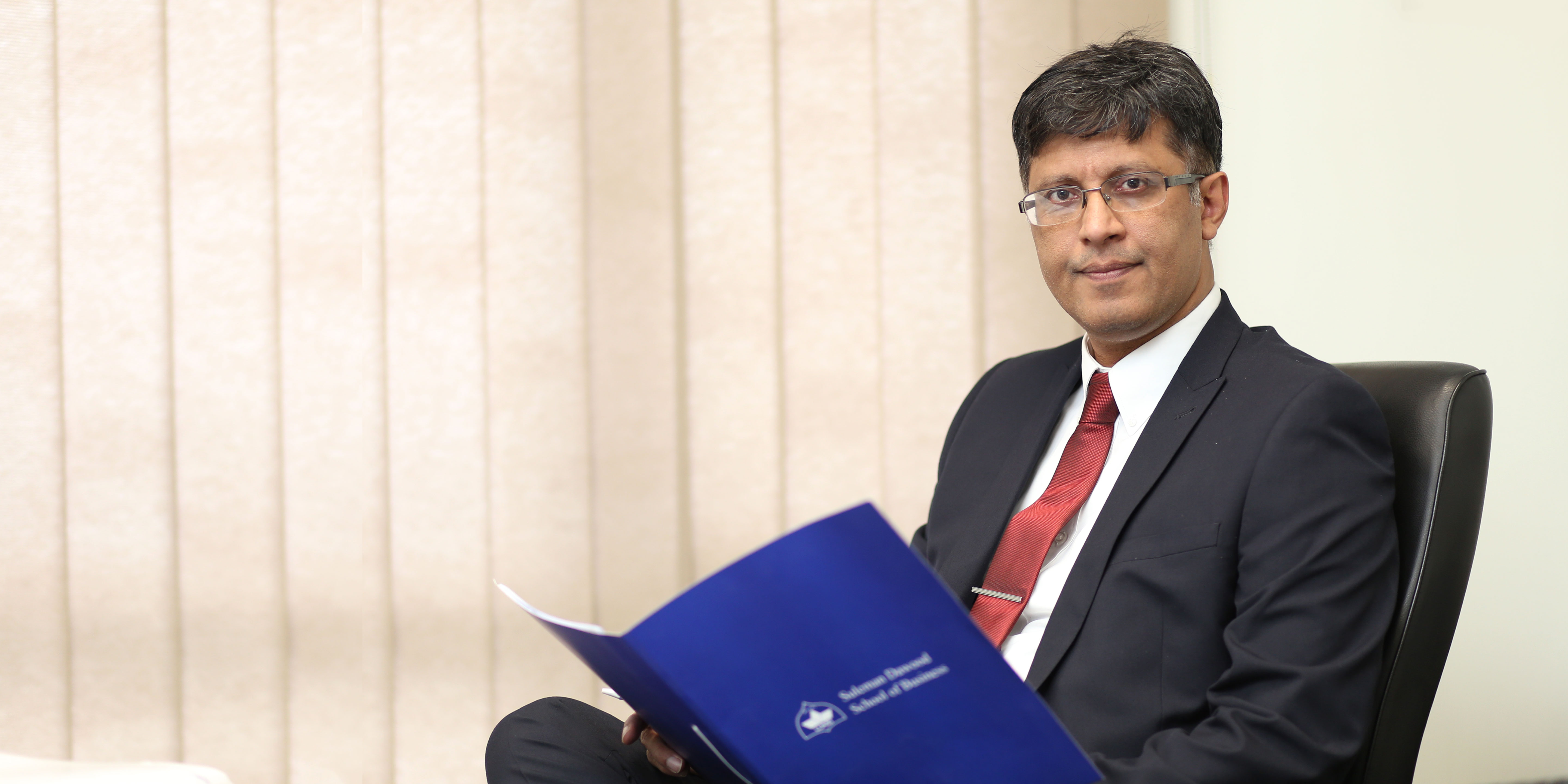
Dean & Professor – SDSB LUMS
EVOLVE: Kindly share with us your academic life and achievements. Please also mention the road map of your professional journey.
Dr. Jawad: I completed my first degree in Engineering from the Taxila campus of UET Lahore. Afterwards, I served various private and public sector organisations in Pakistan. I proceeded to Australia to complete my Masters in International Business from Western Sydney University. After that I came back and served the industry again for a couple of years and then proceeded to complete my PhD studies in Business at Macquarie University, Australia. I did my Post Graduate Certificate in Higher Education from the University of Kent, UK and attended Institute for Management and Leadership in Education (MLE) at Harvard Graduate School of Education (HGSE), Harvard University.
EVOLVE: How would you define ‘Academic Leadership’?
Dr. Jawad: It is very demanding, complex and comes with a lot of responsibility. While there may be some element of authority but it is more of a responsibility .Within an academic organisation, it is more colloquial than authoritative and particularly at LUMS it is more shared governance based. Basically it is more of a collective journey and collective responsibility that is placed on the shoulders of a Dean or an Associate Dean, Academic Director and other colleagues within various capacities. We have to work together, not only for the excellence of our students but also for the betterment of our business community, the collective good of our profession and the larger society.
EVOLVE: In your perspective, what is that one leadership skill that can be applied in our Education and Business sector?
Dr. Jawad: I would say that business engagement would be something which would be most important; particularly in the context of LUMS. Personally I remain KPI (key performance indicators) oriented while working with academic and administrative staff, business partners and other stakeholders. As you know, in Pakistan, academic institutions have been imparting business education for almost the last four decades, but the question is, to what extent are the skills that we are imparting to our students, relevant and applicable to the industry needs. To match the industry needs with the skills that we seek to develop in our students, it is important to ensure how business engagement could be enabled and incorporated within our academic content and executive development programmes, to engage the industry within Pakistan and abroad.
EVOLVE: How would you describe the working atmosphere of your University and the people with whom you work?
Dr. Jawad: It is very fulfilling. For example, in terms of faculty, here at the Suleman Dawood School of Business (SDSB), we have built up a galaxy of foreign PhD qualified colleagues. SDSB has sixty faculty members out of which forty-six hold PhD degrees, and all except two have PhDs from some of the most reputable foreign universities. This not only depicts the diversity of talent, but the diversity of potential and sensitivity as well. One is required to put all these things together and work in an environment where we should be utilising the most of their skills.
EVOLVE: What category of learners and instructors fit in best at your University?
Dr. Jawad: Those who can tick all the boxes! Especially those who should be able to not only provide excellence in teaching in the classroom and executive teaching, but also be able to publish world-class research articles. Here, I am not referring to academic journals in Pakistan, particularly those of questionable academic quality. I am talking about international journals of high standing and repute. At the same time, they should be able to offer consultancy to industry, with the ability and resolve to address some of the perennial issues such as doing business in the digital era in an increasingly globalised world. They should be able to write and showcase Case Studies in order to help our business partners within Pakistan and abroad to learn from real-life business situations. Case pedagogy or the participant centred learning is a unique feature of teaching and classroom experience at our business school which develops our graduate students to critically understand and address actual organisational scenarios. In order to be recruited at LUMS as a faculty member and even as a staff member, people should be able to offer and demonstrate that they have multiple dimensions of success, or potential of success.
Coming towards the category of learners, Pakistan is a country of two hundred and seven million inhabitants, but there is only one LUMS. Indeed, there are other decent universities and business schools in Pakistan, but LUMS is unique by virtue of its very formation, ethos, pedagogy, faculty and business engagement. It has been ranked among one of the top Universities in South Asia and this is something which is acknowledged not only nationally but internationally also.
EVOLVE: What is the unique factor of MBA from LUMS than MBA from other Universities?
Dr. Jawad: Initially, LUMS only offered the MBA programme. That is how we started back in the mid-1980s. Over the years, by the virtue of the success of our MBA programme, the University expanded and now we have five schools; School of Business, School of Law, School of Humanities and Social Sciences, School of Science and Engineering and the School of Education. Suleman Dawood School of Business (SDSB) – the business school is the flagship school of LUMS and MBA is our flagship academic programme.
a. What exactly is unique about the LUMS MBA is that we are the only business school in Pakistan which offers participant centred learning, a pedagogy where the students are expected to understand a real life organisational situation and then offer their solution. It is not only about the instructor who is teaching them in a monotone or in a unilateral manner. Each student present in the classroom has to take part in the solution of the specific case study. This Case Study Method is unique to LUMS and Pakistan.
b. The second thing is that we are the only school in Pakistan and perhaps in South Asia which has a large collection of indigenous case studies on organisations, written by our faculty members. We have a collection of more than eight hundred case studies and some of them are also now showcased by the Harvard Business Publishing website. This is a testimonial to the quality of case studies and business related engagements which have been produced by LUMS and our faculty in particular.
c. I am proud to say that the quality of faculty that we have is unmatchable with any other institution in Pakistan and with many other institutions in the region. Similarly, we are very careful in terms of our student recruitment and they have to undergo a rigorous process of selection. We believe not in quantity, but quality. When we recruit a student, we not only look at his/her academic performance but we are the only business school as far as I am aware, which requires a decent GMAT or GRE score for MBA admissions. Plus, we prefer professional experience because unless they have professional experience, they would not be able to understand the discussions and discourse of case studies and other academic content in the classroom.
EVOLVE: What future do you foresee for Pakistan’s youth, when compared to their future abroad?
Dr. Jawad: We would want Pakistan to come across as an attractive job market. Ideally, we would like our organisations, whether public or private as well as MNCs, to be able to attract, recruit and retain our graduates. Hence, ideally there should not only be a push factor but also a pull factor from the organisations and the wider society. Indeed, from our students and alumni, our expectation is clear that they have to have excellence in intellectual and leadership capabilities; they have to be a role model in integrity, in ethical conduct. We expect that a student from LUMS is somebody who will never tell a lie nor who will never be involved in corruption or nepotism.
Merit is one of our basic values at LUMS and so is integrity. Never in the history of LUMS have we ever compromised on merit in our admissions and also in our graduation criteria. So that is something that we emphasise a lot and we try to inculcate the same values in our students and graduates. Pakistan has huge possibilities. It is currently the sixth largest country in the world. Pakistan, with the median age of around twenty-two years is the youngest country in South Asia and one of the youngest in the world. That provides a lot of opportunities but also places enormous responsibilities upon our shoulders, upon the shoulders of our graduates, and also upon their prospective employers and the society at large.
EVOLVE: What projects are you working on currently?
Dr. Jawad: Personally, I am working on a book which would capture the research and case studies related to CPEC and the Belt and Road Initiative, more broadly speaking. I am working on this book with Professor Frank Ying who is a Fellow Dean at National Taiwan Normal University. Other than that, I have recently completed a book, “Knowledge Management” which will be published by Palgrave Macmillan.
EVOLVE: Is there anything you ever wished to do differently in your profession; or a skill that you wanted to learn while in the early years of your educational period?
Dr. Jawad: The only skill which I would like to somehow master myself would be to have more than 24 hours in a day; there is a lot to do but unfortunately the time is very limited. Overall, I believe the School is moving in the right direction. With the collective support and participation of my faculty members, students, administrative staff and all other colleagues and stakeholders, we should be able to achieve our targets.
EVOLVE: In your opinion, is it possible to implement overseas educational development plans in accordance with LUMS strategic plans for education?
Dr. Jawad: Not only have I studied abroad but I have also taught there for ten years. I was a full Professor at University of Huddersfield, Associate Professor or Reader at the University of Kent, UK and I have also taught at Macquarie University, Australia. Hence, based on my own experience of teaching and working at these universities, I can comfortably say that the quality of education that we design and impart at LUMS is comparable to all decent and reputable universities in the world. The issue that we face is societal, for example, in terms of the ethos and academic orientation of students that are being developed in primary and secondary schools.
EVOLVE: How does LUMS contribute to its employees’ professional development?
Dr. Jawad: We make a lot of investment in our employees, not only in terms of financial resources but also the eco-system and opportunities for development. We invest in terms of time, mentoring and training which we make available to them. Every year at least four to five faculty members from LUMS, and from SDSB alone, are sent to Harvard University or to Ivey Business School, in order to get specific training on Case Method Pedagogy. We also continue to invite eminent scholars from abroad.
EVOLVE Kindly share any distinct professional challenges and accomplishments with our readers.
Dr. Jawad: The challenges that we face, unfortunately most of them do not have much to do with LUMS and SDSB in particular; they have to do with the specific socio-economic and political situation of Pakistan. Therefore, sometimes when we have to invite eminent scholars, faculty members or even students to come to LUMS, some of them are anxious about their safety. In terms of accomplishments, the very fact that we are recognised as the leaders within Pakistan, and amongst the top eight in South Asia is reassuring to us. Nonetheless, the situation has improved in the last two years and we will continue to work on internationalisation and diversity.
EVOLVE How do you think the graduates of LUMS are contributing to the vision of a better Pakistan?
Dr. Jawad: The fact that many of our graduates are working at top level positions in business organisations, MNCs, public sector organisations across many cities and sectors in Pakistan, and also overseas, is a testament to the quality of our graduates. The very fact that many public and private sector organisations continue to approach us for their training, consultancy and executive development also makes us proud of our unique capabilities. We are making a humble contribution to our country; we would like to add more value to our society and hope to achieve even better results.