Search here
 Log In
Pakistan's Economic And Financial Future: Must - Know For Leaders
The “Future of Pakistan” which draws attention to the views expressed by a particular group of international experts about the future prospects of Pakistan, was heavily influenced by the dynamics of socio-political factors. However, to plead the case of Pakistan in front of the global community, no foundation other than economic and financial could be substantial.
Pakistan’s economy has shown its potential in the past, as there have been many episodes of high growth rates. Stephen Cohen himself argues that the economy of Pakistan might be the easiest one to start with and revolutionize. The social consequence of a progressing economy would be that it could ease the anger of a deprived social class by improving their life style and economic base which will then give them access to better education. This can change their preference for democracy from autocracy and will promote ethnic tolerance. In short it would completely alter the future of Pakistan. Thus, an analysis of Pakistan purely on an economic foundation can be more promising in predicting its future.
Ten years ago, Jim O’Neill and his colleagues Dominic Wilson and Roopa Purushothaman, while working on different economies, also highlighted the notion and importance of economic foundations in predicting the future and growth prospects of a country. Their original work was for four economies collectively called as BRICs (an acronym for Brazil, Russia, India and China). They selected these countries purely on the basis of their large population and their potential to trigger high economic growth. They called these economies as the next growth engines of the world after having identified some of the key factors that possibly drive the future growth potential. They extended their work to other economies when over time their predictions about the future of BRICs countries were proved accurate. The next economies were chosen as they were the next set of large-population countries beyond the BRICs. Pakistan was also included in the set of the Next-11 countries; and predictions were made about its future prospects based on its economic potential. Jim O’Neill et al were relatively optimistic about Pakistan even though they recognized that the country faced large challenges.
In what follows, we present a brief snapshot of the framework developed by Jim O’Neill and his colleagues, which was originally applied to BRICs and then extended to the Next-11. We highlight the future of BRICs that was predicted by this team of economists in order to establish their credibility; and then we draw attention to the future of Pakistan as foreseen by O’Neill et al.
Variables Shaping the Future
According to O’Neill, the measure of being developed vs. developing or emerged vs. emerging is the GDP of a country; where GDP is the function of the country’s labor force, productivity; and its growth environment which in turn can be measured through the Growth Environment Score (GES). Hence the variables that may predict the future of a country are:
- Size of a country’s labor force and national productivity
- Growth Environment Score (GES)
1. Population and Productivity
One of the most influential factor that has an absolute ability to determine the path of the future growth for any economy is the size of its population. This idea was repeatedly reinforced by O’Neill at almost every alternative page of his book. To achieve sustainable growth, the presence of a large, young and growing population is so vital that while discussing Brazil, (which is at present the second largest economy in BRICs and has a potential to overtake Germany and Japan very soon) is likely to be overtaken by India, just because of the sheer number of Indians. The importance of a huge population size is because of the fact that it can reduce the required productivity threshold for any nation.
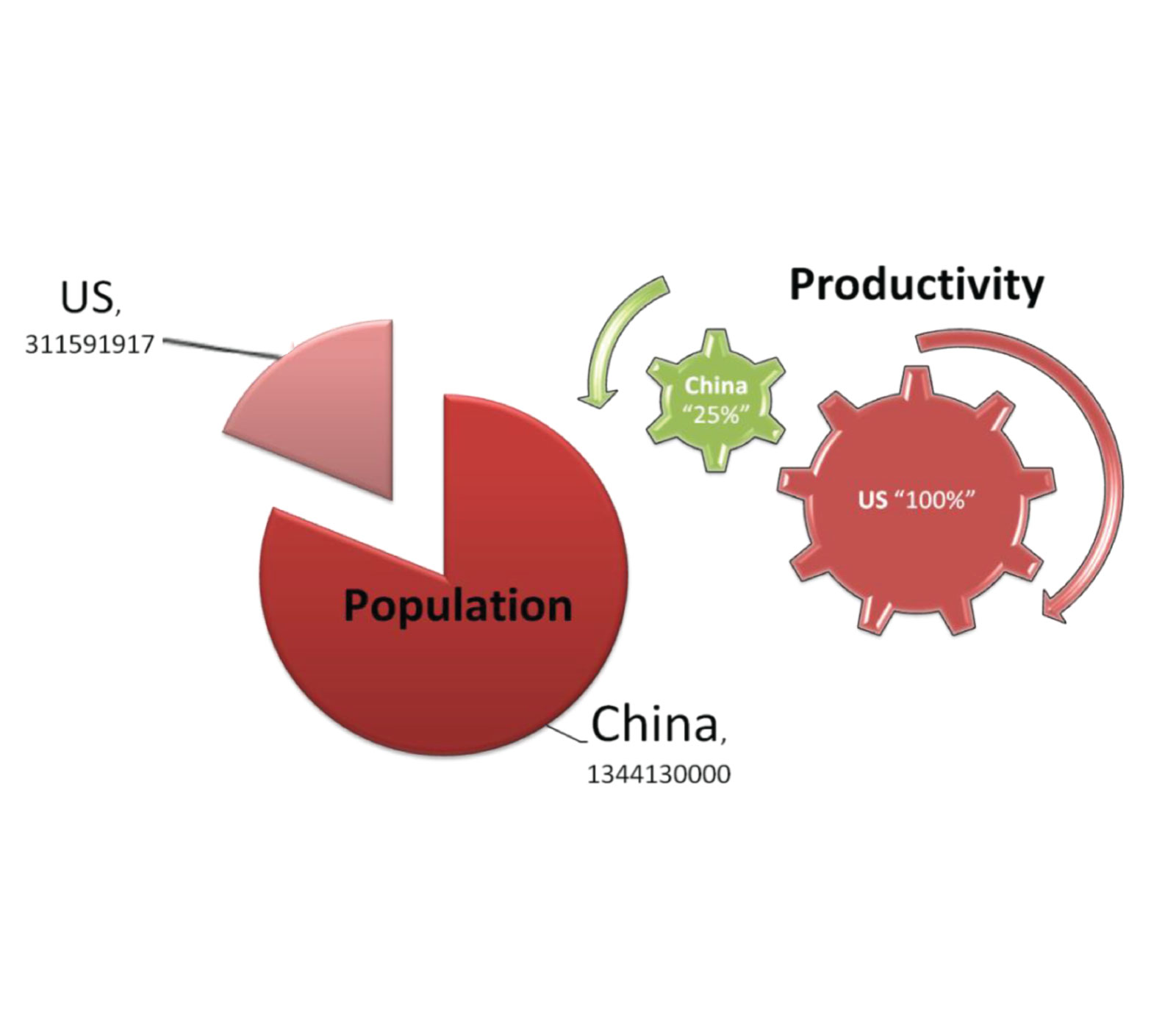
The smaller the size of a country’s population, the more productive will have to be its labor force in order to achieve a certain level of output or GDP growth. Whereas, with a large population size a country’s labor force can still achieve the same level of output despite being less productive. For example, China is four times the population of US, so its workers only need to be 25% productive as compared to the productivity of US workers in order to achieve the same level of output being produced by US.
2. Growth Environment Score (GES)
Growth Environment Score (GES) estimates the degree of conduciveness of an economic environment for output growth. Goldman Sachs has proprietary rights over this idea and it has proven itself not only crucial but also robust in determining the potential growth of any economy. There are 18 variables divided into six broader categories forming this GES index; where these variables can take the value from 1 to 10 (10 being the most conducive environment). In the case of variables where higher values means non-conduciveness, the values have been inversed. The following table can help the reader in understanding the overall structure of the GES Index.
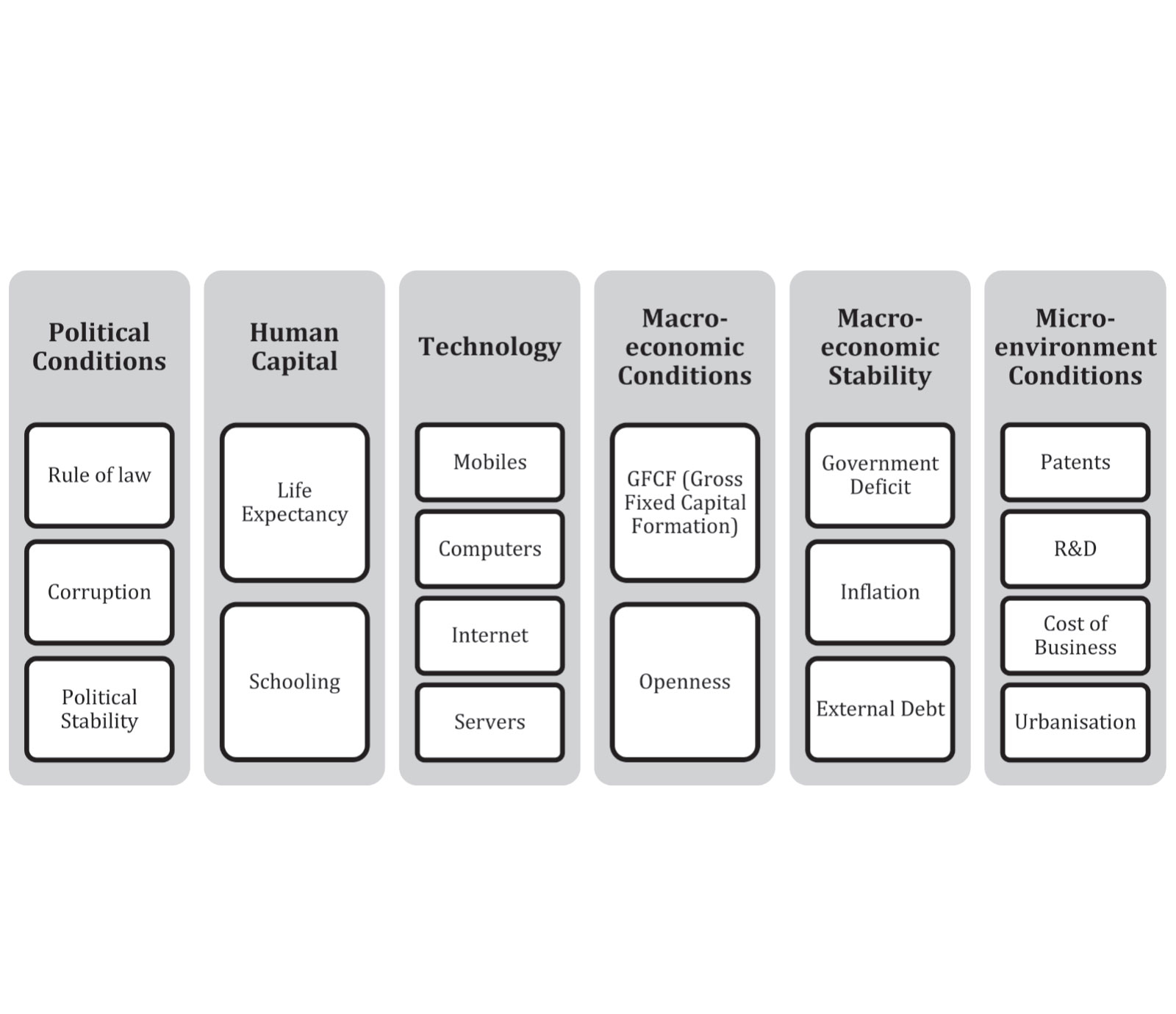
Source: O’Neill (2011) The Growth Map: Economic Opportunity in the BRICs and Beyond
Growth environment score is in fact an indication of whether the economy is able to realise its true potential which it may have in the shape of a large, young and growing population and other resources. According to O’Neill a large population undoubtedly reduces the threshold a country needs to achieve in terms of productivity, yet it is critical for sustaining growth and helping in improving welfare. Each variable included in the GES has strong linkages, direct or indirect, with increased level of productivity and it has shown itself as a robust measure to explain growth and productivity levels across countries when it was back-tested on the past fifty years of data.
These two broad factors: population, productivity and growth environment score; form the basis of the idea developed by O’Neill and his colleagues to perform a country analysis. They used them to evaluate the economies of BRICs and anticipated their futures as can be seen in the following figure.
BRICs
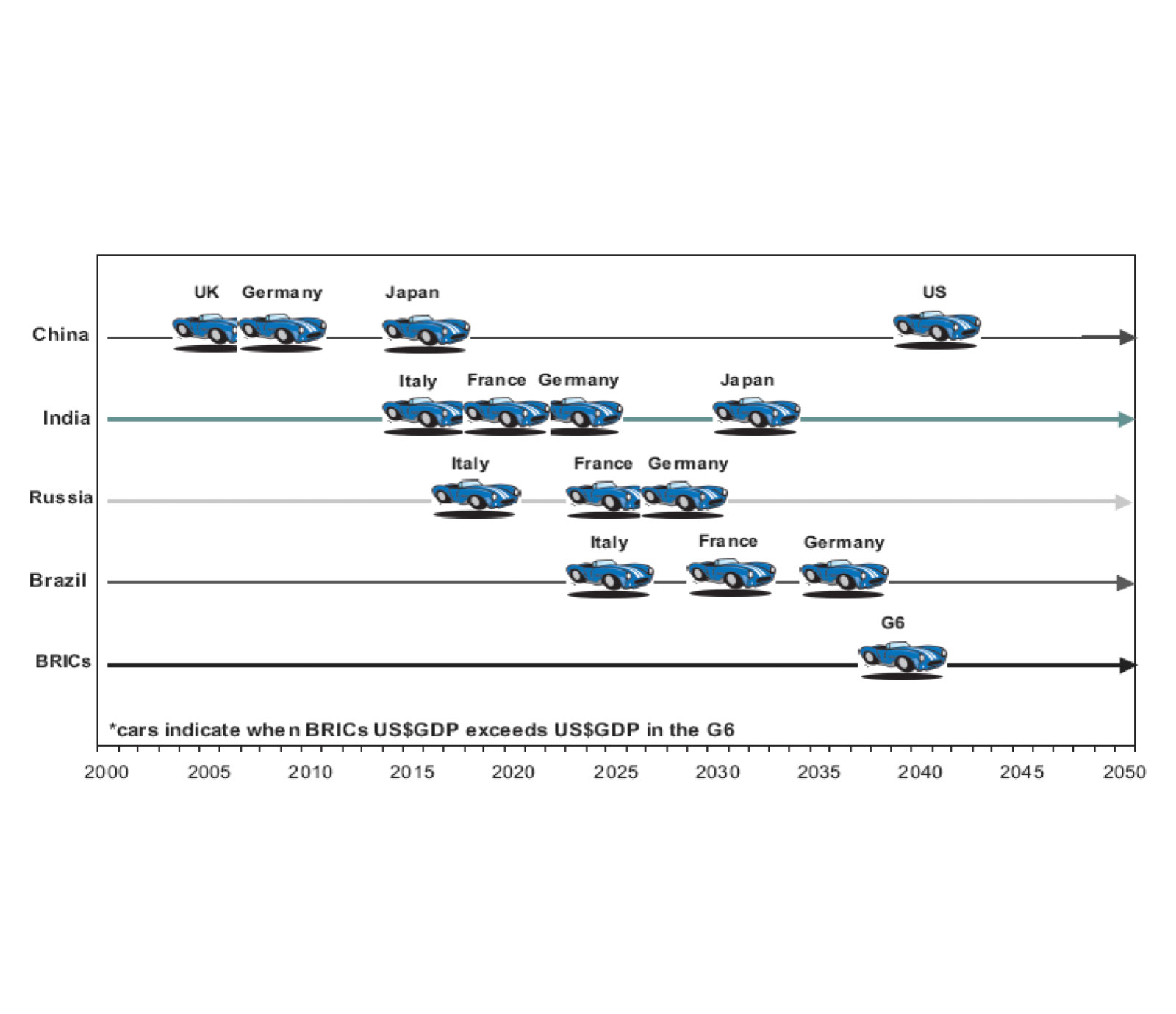
Source: “Dreaming With BRICs: The Path to 2050”, Global Economic Paper No. 99, Goldman Sachs
The framework of O’Neill et al, predicted, that BRICs would be the next growth economies of the world. They would gradually overtake the economies which currently constitute the G6 one by one; and by the end of 2040, BRICs would supersede the G6.
Only a short time period of 10 years post-prediction revealed that whatever they predicted about BRICs (based on the variables they thought were the decisive factors), proved correct, even before their projection time period ended. If we only consider the example of China, they predicted that China would overtake Japan in terms of US$GDP by 2015 but China has already overtaken Japan at the end of 2010.
N-11
Though the credibility of O’Neill framework was established by relatively recent facts; they had confidence in their model and variables much earlier since they decided to extend their analysis to other countries in 2005 and introduced a new acronym Next-11, where Pakistan was also made a part of it.
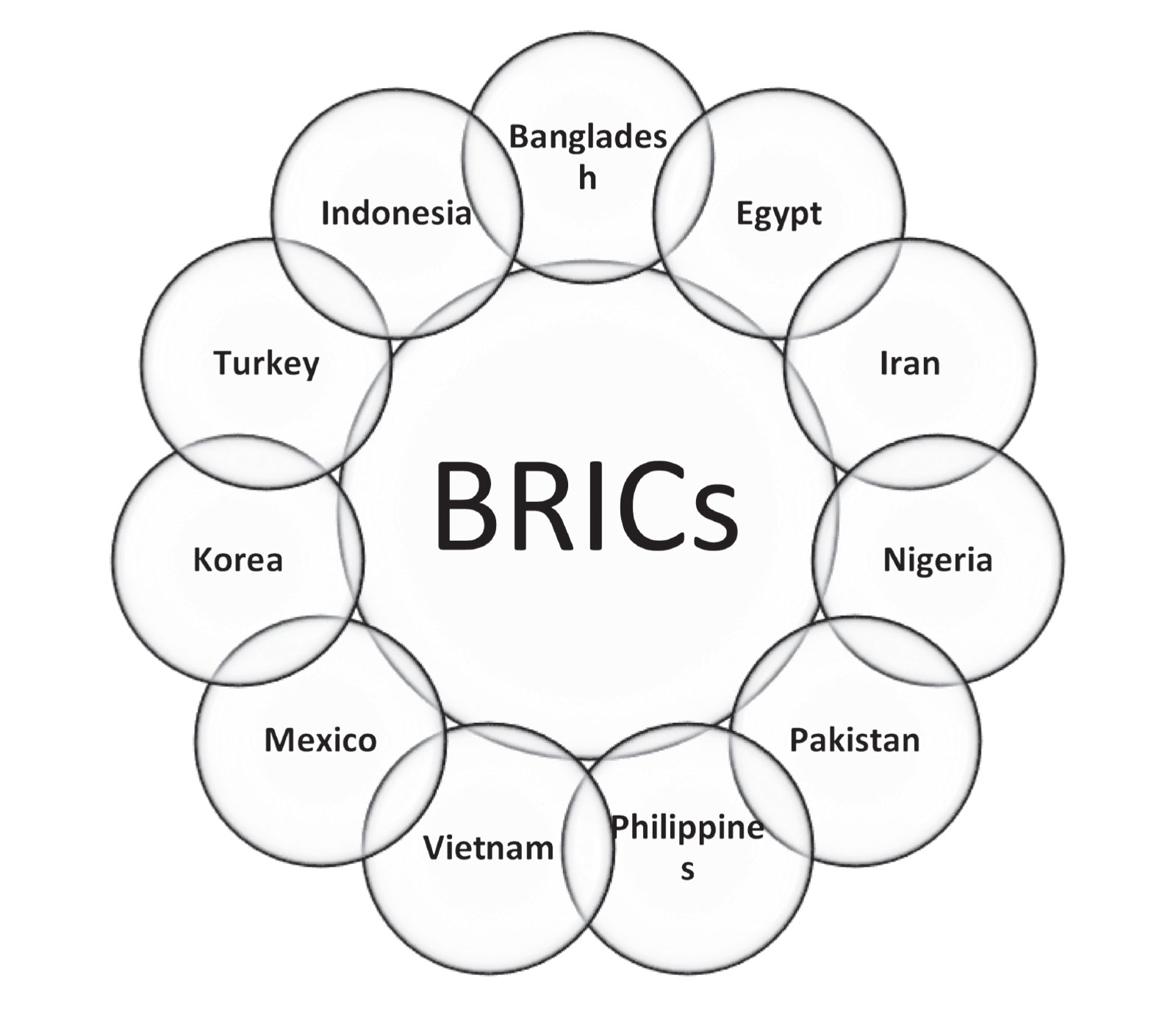
These 11 countries which form a very diverse group were selected because they were the next set of large-population countries beyond the BRICs. As population potential has been considered the key driving factor of growth, they were assumed to have a BRIC-like impact in rivaling the G6 and the G7. Some of these economies like Korea and Mexico were already well-known to investors but some became known to them after the introduction of the acronym N-11 (such as Nigeria, Vietnam, Pakistan and Bangladesh).
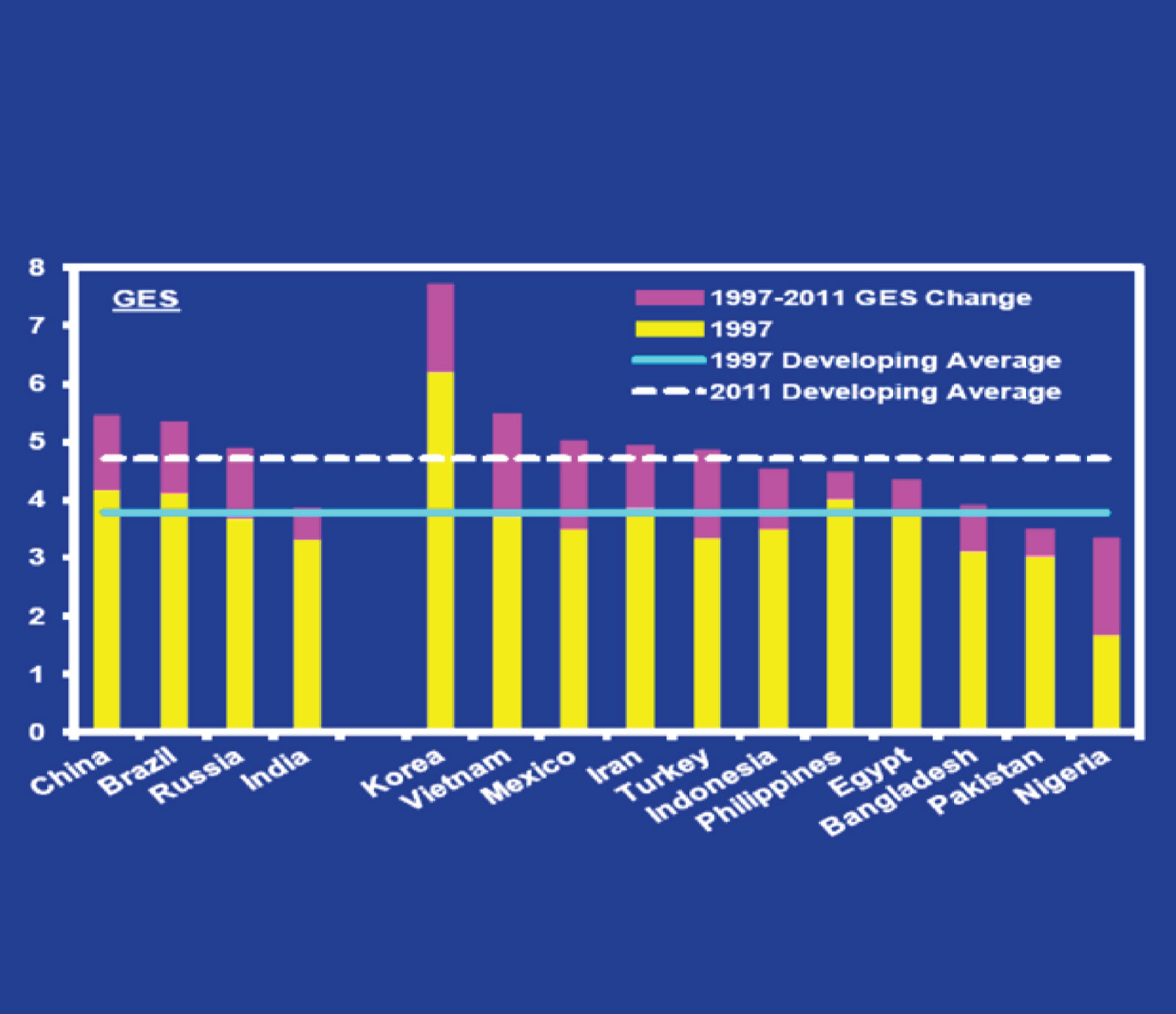
O’Neill et al took a similar approach to their BRICs analysis, looking in detail at what some simple assumptions for the growth process (population, productivity etc.) imply for the N-11 economies, and benchmarked these against the BRICs. They also compared growth conditions, using their Growth Environment Scores (GES), highlighting the strengths and weaknesses across the group. The recent Growth Environment Scores of N-11 countries in comparison with BRICs countries are given in the following figure.
BRICs and N11 : 2011 Growth Environment Scores
Source: Outlook for Global Economy, GSAM, May 2012
The GES suggested that so far concrete progress (1997 to 2011) has been uneven and modest amongst and across groups. This highlights the fact that the capacity to deliver on the growth potential and underlying growth conditions varies greatly across these economies. Korea rates higher than even BRICs economies, while Bangladesh, Nigeria and Pakistan rank the lowest in all the countries (including BRICs and the N-11). The diversity of the N-11 countries made it hard to generalise the predictions for the N-11 as a group, which could be done for the BRIC economies. Some of the N-11 countries also showed their similarities with BRIC economies in terms of underlying growth conditions. There was a need to re-classify all the BRICs and the N-11 based on their ongoing growth environment developments. Jim O’Neill then proposed a new classification, for all the economies studied earlier as BRICs and N-11, which are Growth markets vs. Emerging markets.
Growth Markets vs. Emerging Markets
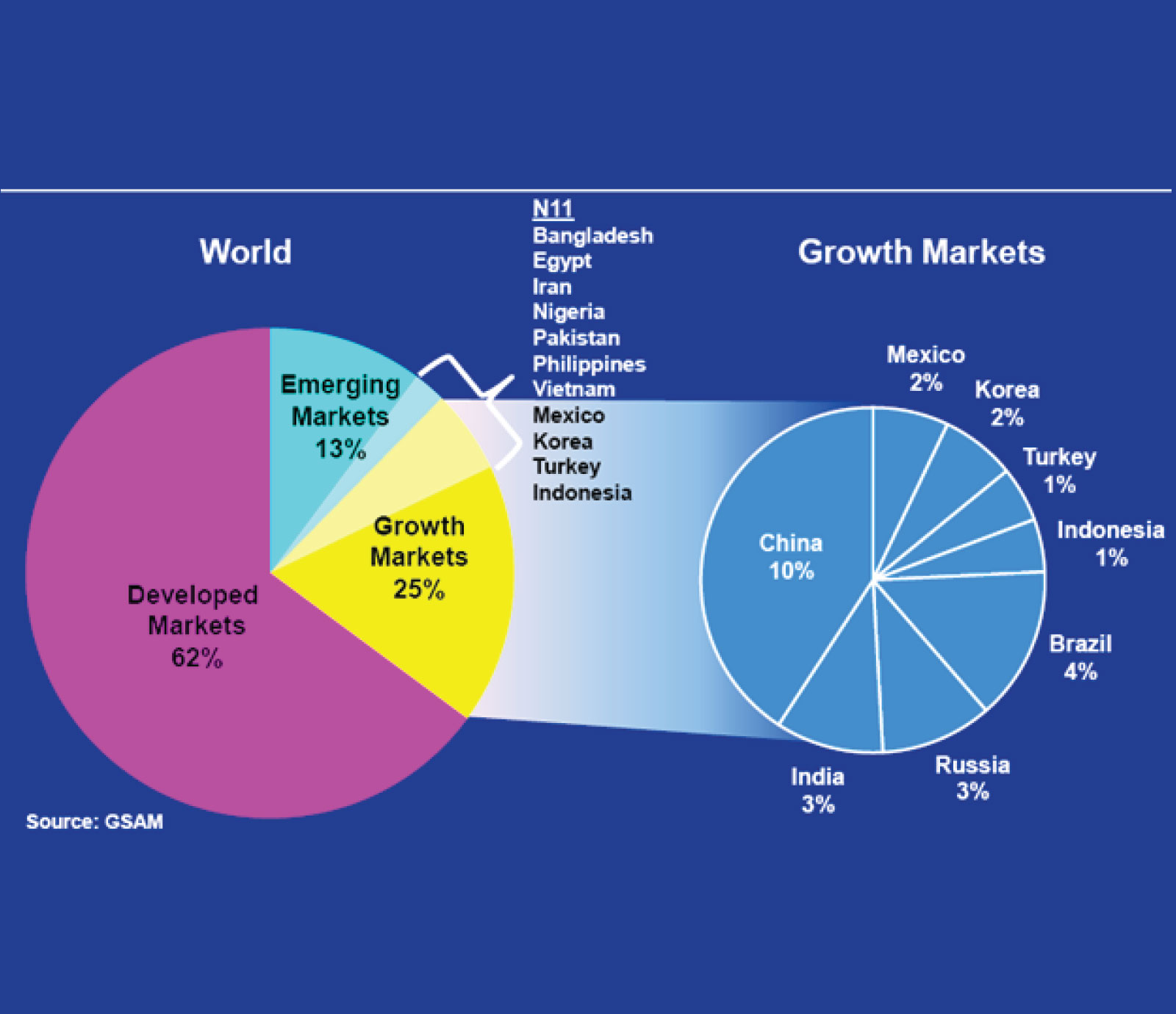
As per the definition of O’Neill et al, a country is classified as a growth market if it contributes at least 1% to world’s GDP; and with less than 1% contribution, it would be termed an emerging market. The new classification and the placement of BRICs and the N-11 countries in the two categories are given below.
Country Classification by 2011 GDP Share
Source: Outlook for Global Economy, GSAM, May 2012
Figure 4 highlights the division of countries into growth markets and emerging markets according to the criterion. Among the group of N-11, Korea, Mexico, Turkey and Indonesia have been placed in to the group of Growth markets, along with the four BRIC economies. This was based on their contribution of more than or equal to 1% in world’s GDP.
Pakistan
Pakistan, which was among the group of countries who ranked the lowest on the Growth Environment Score in 2011, is again not a part of growth markets based on its 2011 GDP share. However, the analysis performed by O’Neill et al still offers hope for an encouraging future prospect of Pakistan. They note that the rationale for including Pakistan in the N-11 few years back was not to establish its position as a winner or loser on the basis of its GES; rather the objective was to analyse if the country has growth potential which can at some point in time bring a BRIC-like impact on the world’s economy.
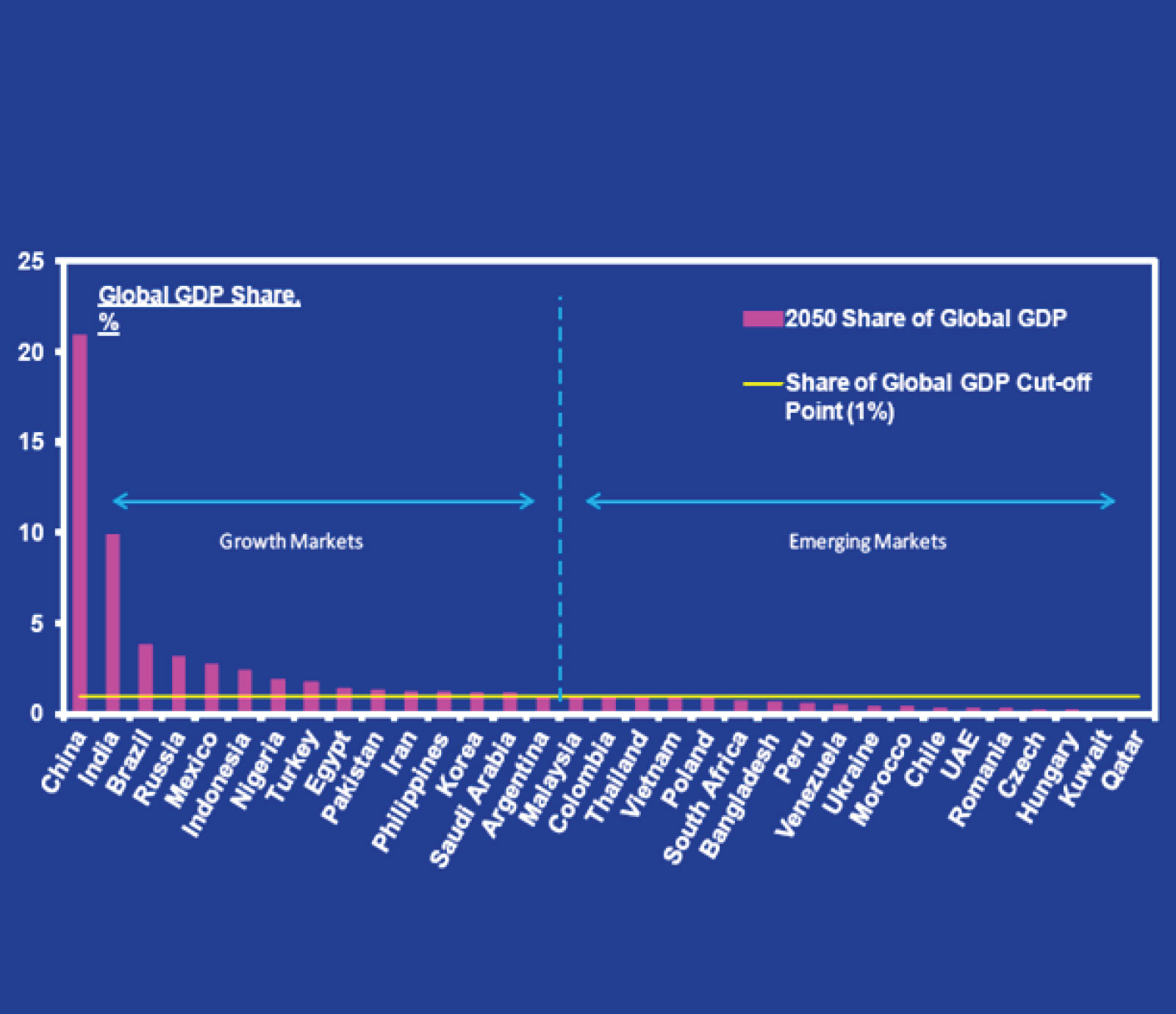
Putting all these observations together, there is no doubt that the current growth environment score of Pakistan is low. It is not making a significant contribution to the world’s GDP and is still classified as an emerging market; but all these calculations do not deny the existence of a growth potential for Pakistan which it has in terms of its young population. This growth potential if combined with some efforts to increase GES can bring Pakistan in to the group of growth markets, as is being predicted by O’Neill et al in their projections of 2050.
Projection for 2050
Source: Outlook for Global Economy, GSAM, May 2012
CONCLUSION
As a concluding note we would like to express our view about the future of Pakistan in an optimistic tone. Despite all the problems mentioned by Cohen and others spanning from the idea of Pakistan to the current unstable political structure and deteriorating social fabric, further threatened by the notion of continuously increasing terrorism, we would like to point out that it is a country hosting more than 180 million habitants. This is indeed a potential that can alone change the entire path of economic growth in any country. If anyone would compare the current position of Pakistan with that of Brazil thirty years ago, a lot of similarities could be easily detected. From hyper inflation, inept highly centralized leadership, perpetual economic and political crisis, continuous switch between democracy and military dictatorship, uneven and unequally shared growth to violent and notorious cities; all of these would suggest to an ordinary reader that we are talking about Pakistan but these were actually the notions associated with Brazil, just thirty years back. There is a dire need to get some improvements in the growth environment score and as mentioned by O’Neill, boosting GES shouldn’t be difficult if leaders are ready to adopt the best practices practiced by other economies. We do not have any intention to negate the concerns raised by Cohen and the group but the other side of the coin shown by O’Neill et al,( which has been entirely ignored by Cohen), is equally important and must be considered while drawing any probable shape of Pakistan’s future.